
ATTENTION: All 2025 Crop Reporting must be done through Producer Connect.


Northeast Nebraska Ag Conference
Co-Hosted by the Bow Creek Watershed and the Bazile Groundwater Management Area
Northeast Nebraska Ag Conference
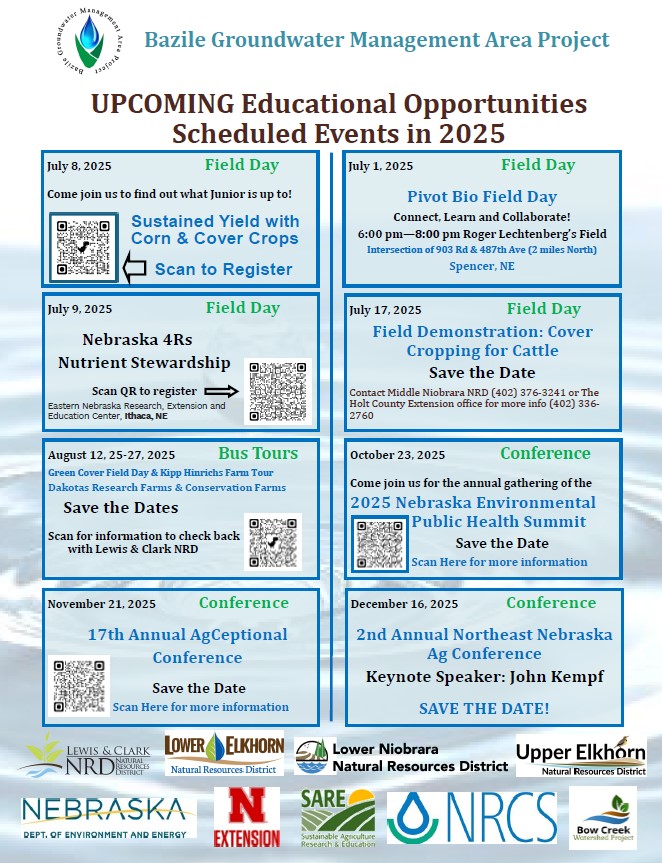
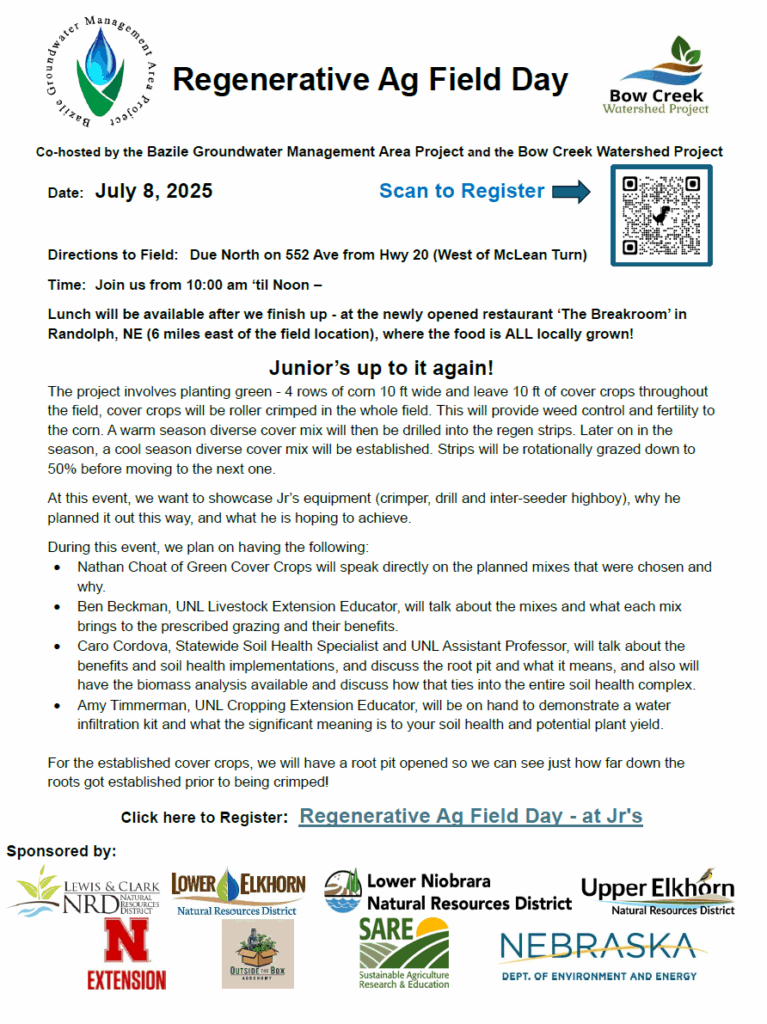
The first annual Northeast Nebraska Ag Conference will be held December 17, 2024 at the Lifelong Learning Center at Northeast Community College in Norfolk. This event is co-hosted by the Bow Creek Watershed Project and the Bazile Groundwater Management Project and produced by the LCNRD, LENRD, UENRD, LNNRD, and NeDNR. All farmers and ranchers are invited to attend to learn how other producers are using conservation practices to improve their bottom line while improving water quality.
The focus of the event is to encourage the exchange of conservation production ideas between farmers, ranchers, and supporting agriculture professionals. Farmers make up the majority of the speakers, sharing their experiences, tips, and tricks. Rick Clark from Williamsport, IN will start the day with the keynote address. Focusing on a regenerative soil health management system Rick uses nature to replace costly farm inputs. He will share his journey into organic no-till and the lessons learned along the way. S Jason Mauck, Mitch Hora, Paul Jasa, Roy Thompson, and others will discuss topics ranging from equipment setup, cropping tips, grazing practices, new technology, value-added products, to discussions on how to get paid for conservation. With fifteen breakout sessions you can customize the day to suit your needs. A local farmer panel discussing how to make these ideas work here will wrap up the day.
In addition to great speakers, this is a great chance to network with like-minded farmers and ranchers. Whether you have been implementing conservation practices for decades, just thinking about implementing them or somewhere in between you will find someone in the same situation to discuss these ideas with. Lucky attendees will take home more than just knowledge. Great door prizes will be given at the end of the day!
Thanks to the sponsors of this event, you can register until December 6th for NO COST! A late registration charge of $20 will be collected at the door and online after December 6th. Use the QR code or visit https:lcnrd.nebraska.org to register.




Phase II Reports are Due
ATTENTION: All 2025 Crop Reporting must be done through Producer Connect.

2nd article of 4 from Flatwater Free Press
OUR DIRTY WATER

OUR DIRTY WATER
No nitrate police: State and local regulators can’t, or won’t, stop our drinking water from getting worse
There are few staff to monitor Nebraska’s vast swaths of farmland, thousands of cattle feedlots, large hog operations and chicken farms. And the agencies’ own regulations don’t give the staff many tools to combat malpractice.
The farmer was growing impatient. He folded his arms. Shook his head angrily.
He and dozens of other central Nebraska farmers had gathered for mandatory training in Columbus a few weeks before Christmas last year. In response to stubbornly high nitrate levels, the Lower Loup Natural Resources District had designated a slice of the region a “Phase 3 area.” That designation led to a few new requirements – like this training to help farmers manage their nitrogen fertilizer use and reduce nitrate leaching.
The farmer didn’t like this. He told NRD leaders that he had been drinking water containing nitrate at 40 parts per million – quadruple the safe drinking water standard – all his adult life. He was fine, he told them.
During the morning session, he stormed out.
“I’m gonna go pollute the water,” he told the NRD’s assistant manager, Tylr Naprstek, right before he left, Naprstek recalled.
There was precious little Naprstek could do.
He couldn’t fine the farmer. He couldn’t send a cease and desist letter. He couldn’t issue a written or verbal warning. He couldn’t do much except mandate this training. And ask nicely.
“We can try to educate, and as long as he stays within the boundaries of our rules and regs, that’s really all we can do,” said Naprstek.
Even as Nebraska’s water grows increasingly laced with nitrate – a reality that deeply worries the experts studying links between elevated nitrate and pediatric cancers – the regulators meant to keep our water clean either can’t, or won’t, do much to stop practices known to cause nitrate levels to spike.
Local NRDs and the Nebraska Department of Environment and Energy have few staff to monitor Nebraska’s vast swaths of farmland, thousands of cattle feedlots, large hog operations and chicken farms. And even when they identify malpractice, the agencies’ own regulations don’t give the staff many tools to combat it, multiple NRD leaders said.
NRDs can place restrictions on when farmers can apply nitrogen fertilizer. They can mandate water testing and nitrate analysis. They can even hold mandatory training sessions like the one the Columbus farmer stormed out of.
But, crucially, they can’t stop a farmer from applying far more nitrogen fertilizer than is needed – fertilizer that can seep as nitrate into the water supply. Their managers can find themselves hamstrung by their own boards, which sometimes fight against the enforcement of rules that the board itself has previously approved and enacted, according to meeting minutes, interviews and emails obtained by the Flatwater Free Press under public records laws.
The Nebraska Department of Environment and Energy, charged with keeping cattle feedlots from polluting our water supply, can take years to react to feedlots showing sky-high nitrate levels. And even when they do, these regulators often take little action – even as they continue to hand out new feedlot permits “like Halloween candy,” wrote Mike Sousek, Lower Elkhorn NRD General Manager in an email he sent to every NRD leader in Nebraska.
Many farmers use their nitrogen fertilizer responsibly, both state and local leaders stress. They apply it using methods that leach fewer nitrates into our water supply. They take into account nitrogen already in the soil. They embrace technologies and best practices championed by the University of Nebraska, and they save money by using their nitrogen fertilizer more efficiently.
They are the agricultural equivalent of drivers, buckled into their seats, driving comfortably near the speed limit.
But, in Nebraska, there’s little way to enforce rules already in place, rules meant to protect our groundwater.
There’s no one to stop the other driver, the one barreling 90 miles per hour down the highway, crossing the centerline, putting everyone on the road in danger.
“There’s no nitrogen police,” Sousek said.
***
For a glance at how Nebraska’s enforcement can be slow and toothless, look at Engelmeyer Farms.
The West Point feeder cattle and hog facility has had high nitrate in some of its downstream wells since 2007. No one drinks from these wells, but sky-high readings are evidence that nitrate is leaching into the water supply.
In 2011, nitrate readings peaked at an astronomical 413 parts per million.
The Environmental Protection Agency’s safe drinking limit for nitrate is 10 parts per million.
Only in August – fifteen years after the initial high readings – did the NDEE conduct a “compliance status inspection” of Engelmeyer Farms because of high nitrate, according to the state’s available public records.
Three prior, more general inspections found the feedlot owner failed to provide proof that they properly inspected waste or manure application tools. Despite the high levels – some of the highest ever recorded in Nebraska – the state’s only guidance was that Engelmeyer Farms needed better record-keeping.
The NDEE’s enforcement at Engelmeyer Farms actually exceeds the work that the department does at other feedlots with high nitrate levels, according to public records.
Five feedlots near Wisner frequently reported far higher nitrate levels than their surroundings in the past 10 years, a Flatwater Free Press review of Wisner area livestock facilities with monitoring data available showed.
Inspectors sometimes noted concerns during visits to these feedlots.
On all five of these feedlots, the department’s groundwater section recommended nothing beyond continued monitoring.
There are 2,600-some active permits for concentrated animal feeding operations, or CAFOs, in the state. Most are cattle feedlots, large hog operations or chicken farms.
Only 367 have been required to install monitoring wells and report water quality results, according to a list provided by state regulators in April.
Four or five staff members in the groundwater section – who have many other duties – are also tasked with reviewing the tests these CAFOs submit twice a year, said NDEE Groundwater Section Supervisor David Miesbach.
“I see it all the time. If I got alarmed by every time I saw something over 10 ppm, it would be a tough day,” said Miesbach.
Miesbach defended the department’s work, saying he and a small staff work with livestock operations diligently, identifying the worst cases, trying to determine where the nitrate is coming from and experimenting with numerous ways to bring levels down.
The department does regulate manure runoff. However, once the manure is applied to farm fields, it becomes local NRDs’ responsibility, NDEE leaders said.
Livestock operations have planted trees and built new waste lagoons to try to improve water quality, he said.
Some of these measures could cost the owners millions of dollars, Miesbach explained. The high cost is one reason the state needs to thoroughly study the site before asking owners to change, he said.
The Flatwater Free Press requested the total number of CAFOs that state regulators have worked with, as well as the total number of livestock producers known to have nitrate issues.
The NDEE didn’t provide a list of livestock facilities it has worked with to address high nitrate. Miesbach said he couldn’t detail when the NDEE will fully determine the causes of high nitrate in livestock facilities with high readings, or how long it will take to address those problems.
The Flatwater Free Press also made a public records request for five years of emails from roughly 80 department employees that mentioned the keywords, “nitrate,” “nitrogen,” “nutrient” and “fertilizer.”
The department quoted the newsroom $44,103.11 to obtain those public records.
This week, the Flatwater Free Press sued the NDEE, claiming the department offered a “legally insufficient and invalid estimate” for those public records.


To Jim Bendfeldt, a longtime farmer near Kearney, there’s nothing more refreshing than drinking cool water his irrigation wells pump in the summer. His family members often cup their hands and scoop water flowing from the irrigation pipes in his fields.
But he won’t let his grandchildren have more than a few gulps, because some of his irrigation wells are high in nitrate.
Slightly less than a quarter of all the Central Platte NRD’s certified irrigated acres – that’s some 225,000 acres – have average nitrate levels that exceed 15 parts per million, 150% the federal safe drinking water standard.
In the past four years, farmers in this area have self-reported using much more nitrogen fertilizer than UNL recommended – on average, 22% more, according to a Flatwater Free Press analysis of data obtained in a public records request.
Some local regulators believe that these self-reported figures are low. Bendfeldt, also an NRD board member, said sales records would show that farmers in the area are using even more. The NRD has no authority to ask for these sales records or identify who’s overapplying nitrate.
“We have no authority to do anything other than accept the online records … and take each producer (at their) word,” he said.
Many farmers and agricultural interest groups cast the nitrate problem as a legacy issue that stems from past practices. They argue that golf courses and lawns are to blame. At NRD board meetings, they protest that more studies are necessary before regulators institute rules that restrict how they farm. They say authorities need to tailor regulations and account for weather, geology and other factors.
“I think there can’t be just a flat standard,” said Nebraska Farm Bureau President Mark McHargue. “We have to base it on science all the way through, so that involves, what types of crops you’re growing, what’s your rotation, what your rainfall is, what your slope on the soil is, what your organic matter is in your soil.”
But the science shows that most nitrates in our water come from fertilizer applied to crops. Years of results from these “nitrate fingerprinting” tests in multiple NRDs point to commercial fertilizers as the most common culprit. The bulk of these fertilizers are applied to corn, said multiple NRD leaders.
Data requested by the Flatwater Free Press shows that farmers in many parts of Nebraska continue to put on more fertilizer than UNL recommends – even though critics say that the UNL recommendations are focused on yield, and should be lower if the damage to our water supply is taken into account.
The free market can help, some argue. Farmers have no incentive to overapply nitrogen, particularly with fertilizer prices so high.
“If farmers blindly apply nitrogen without knowing what’s in the soil or what’s in their manure or what their crop needs are, they’re literally throwing money out the window, and they’re not going to do that,” said Andy Scholting, the founder of Nutrient Advisors, a consultant to both livestock and crop producers.
But an entire industry is built around encouraging Nebraska farmers to use more fertilizer, argues Ronda Rich, an Upper Big Blue NRD board member.
Agronomists are often paid on yield, she said. People who sell fertilizer also advise farmers on how much fertilizer to buy.
Armed with few tools, local regulators can’t do much to combat this, she said.
Yet the regulators themselves are far from blameless, said Tim Gragert, a Republican state senator from Creighton. Gragert once worked for the Natural Resources Conservation Service, which helps farmers with soil health. He sits on the Legislature’s Natural Resources Committee, and authored new laws, one that created a task force that studied nitrate and another that strengthened nitrate education.
He doesn’t mince words on Nebraska’s Natural Resources Districts.
“They’ve already been given that authority to do what they need to do. They’re not doing it,” he said.
***
In late 2020, staff in the Lower Elkhorn NRD proposed that an area should be elevated to Phase 2 in parts of Cuming, Colfax and Dodge counties, subjecting the area to heightened regulations to control nitrate leaching.
They did so after nitrate levels had met the threshold laid out in the district’s own rules – rules the elected NRD board had previously approved.
But the board decided not to go along with its own rules. It tabled the motion to go to Phase 2 – which would have imposed more regulations, including a ban on fall and winter application of nitrogen fertilizer, an 80-pound maximum of nitrogen fertilizer per single application, and mandatory soil and water sampling. Instead, it voted to conduct more testing.
“We seem to want to just kick this can down the road to just study,” Sousek said at the board’s September meeting. “We’ve had this in place in Pierce County for 20 years and we’re still studying, and the problems aren’t getting any better. ”
After a long pause, he continued: “If we aren’t gonna follow our own rules, maybe we need to change our rules.”

This sort of tension isn’t uncommon. Leaders of natural resources districts – local government units created by the state to protect natural resources – often find themselves being slowed down or opposed by board members, who are locally elected, when the leaders try to enforce rules related to water quality.
At the same meeting, Matt Steffen, a board member from West Point, argued that the rules should differentiate different soil types and the board should wait for the test results to come in. “This information is going to greatly help people understand.”
Mark Hall, the chair of the board, agreed that it’s best to wait for more study.
“We’re talking about what I would consider maybe a 70-year-old problem, and we’re going to make a decision within one year to affect the whole area. I would rather be a little conservative and make sure we understand the science before we make a change,” he told the Flatwater Free Press.
That inaction frustrates both NRD staffers and board members who favor regulation, who argue that their own test results have shown nitrate levels are getting higher – and that they likely affect area residents’ health. For example: Nebraska has the highest pediatric cancer rate west of Pennsylvania, and many of these cancers, researchers say, are linked to high nitrate levels.
Board member Joel Hansen urged the full board to at least vote on creating the Phase 2 area.
“The board’s making the decision not to follow our own rules by not doing anything,” Hansen said in an interview.
But being a board member who favors regulation is often a good way to lose your board seat.
In the November election, Hansen was defeated by Plainview farmer Jim Aschoff, who was once issued a cease and desist order for failing to submit an annual report on his fertilizer use, yield goal and his land’s water quality.
What happened in Lower Elkhorn NRD isn’t an isolated case.
In 2019, a board committee of the Upper Big Blue NRD discussed introducing a rule to ban the application of anhydrous ammonia, a nitrogen fertilizer, in the fall in areas where median nitrate level reaches a threshold. The committee then voted to not move forward with this rule change.
Later that year, the board proposed another rule to require split application, a method of applying fertilizer to reduce the amount of nitrate that seeps into the water. Another proposed rule would have capped the amount of fertilizer that can be applied in certain areas before April 1.
More than a dozen residents, mostly farmers, spoke at the public meeting to oppose the rules or ask for additional studies. The board then voted to remove the proposed changes.
Three years after the board scrapped these rule changes, nitrate levels have spiked. Eight of the district’s 12 zones had an increase in median nitrate levels. In three of these zones, at least half of the sampled private wells — which provide drinking water to rural residents — now have nitrate levels higher than the 10 ppm safe drinking water limit, according to the NRD’s most recent test results.


In many areas, median nitrate levels in Upper Big Blue NRD have trended up between 2019 and 2022. (Data: Upper Big Blue NRD / Maps: Hanscom Park Studio)
The NRD Phase System, Explained
Nebraska’s Natural Resources Districts commonly create phase areas to address high nitrate. Each NRD sets their own rules and thresholds for these different phases, but all have trouble enforcing the requirements these phases are meant to trigger.
Phase 1: Areas that have the lowest levels of nitrate. Usually no reporting or other requirements, depending on the NRD. Some NRDs require training and groundwater analysis for nitrate at this level.
Phase 2: “Special management practices” typically start here. They sometimes include bans on commercial fertilizer application in the fall and winter, because applying fertilizer then is more likely to cause nitrate leaching into the water supply.
Phase 3: Additional requirements are sometimes put into place. In Phase 3, some NRDs try to discourage the use of anhydrous ammonia by requiring that farmers also use an inhibitor chemical that helps stop this type of fertilizer from leaching nitrate into the soil. Some NRDs require split application, which limits the amount of nitrogen fertilizer at any one time.
Phase 4: Only certain NRDs even have a Phase 4 on the books – a phase actually meant to limit the amount of fertilizer that can be used.
But no NRD has ever designated any area Phase 4, NRD leaders said.
Central Platte NRD General Manager Lyndon Vogt said there probably should be some areas in this phase. “If we were to go to a Phase 4, we don’t have the ability to enforce that,” Vogt said. “I think everyone’s struggling with what that next step is.”
Self-reported data from the district shows farmers on average have applied more than the UNL recommended level of nitrogen fertilizers in the past four years.
Rich, the Upper Big Blue NRD member, said her board, packed with members with tight connections to agriculture, has failed its duties in educating the public about the threat of nitrate.
Some board members actively seek to hamstring efforts to strengthen regulations, she said. Some board members repeatedly vote no on issuing cease and desist orders to farmers who fail to comply with the district’s rules – even though those rules, like reporting your nitrogen fertilizer use, don’t even carry penalties even if the farmer’s fertilizer use is sky-high.
Rich lost her re-election in November, falling to a challenger who has two brothers already on the NRD board.
At the September board meeting, staff brought in a new University of Nebraska Medical Center study that shows geographic correlation between areas with high pediatric cancer and birth defect rates and areas with high nitrate levels, Rich recalled. The researchers used the NRD’s own data.
The water committee’s chairman John Miller said, “There are some things in there that I personally am not sure are valid.” Miller then quickly ended the discussion on high nitrate and cancer.
A network of consistently monitored wells in the Upper Big Blue district shows that, in the past decade, nine of the district’s 12 zones have seen nitrate levels increase.
***
Two of the wells that supply Wisner’s drinking water have been getting worse for years, and one veered into dangerous territory this year after its nitrate levels shot as high as 11 parts per million.
The town in northeast Nebraska’s Cuming County has issued multiple drinking water notices to its roughly 1,200 residents, and has been forced to provide bottled water to pregnant people, nursing mothers and infants under six months old.
In the meantime, a feedlot a few miles outside town has shown consistently high levels of nitrate in its water. Earlier this year, a monitoring well at the feedlot skyrocketed to 232 parts per million.
State regulators have inspected the feedlot twice since 2018. They have found no issues. They requested nothing from the feedlot’s owners.
In an interview in October, Miesbach confirmed that the monitoring data shows high nitrate, but said he hadn’t yet contacted the feedlot.
This northeast area of Nebraska is home to some 1,800 livestock facilities, the most of any region in the state.
Fewer than 100 of these feedlots and other animal operations even have on-site monitoring wells, said Sousek, the NRD director in the area – meaning that state regulators are flying mostly blind.
Sousek thinks these feedlots, regulated by the NDEE, have contributed to his district’s high nitrate in groundwater, he said in emails obtained by the Flatwater Free Press under public records law.
“On one hand (NDEE) is preaching to the NRD’s that we need to clean this mess up to meet standards, on the other hand they’re handing out permits like Halloween candy,” wrote Sousek in an email he sent to every NRD manager in Nebraska.
The NRD itself has repeatedly stopped short of more aggressively regulating farmers’ use of nitrogen fertilizer.
It has only recently begun sending cease and desist orders to farmers when the farmers repeatedly failed to fill out crop reports. It has declined to bring lawsuits and levy fines against those who refuse to comply with these orders related to nitrate management, though Sousek noted that many farmers do comply after conversations with NRD staff members.
And Sousek’s own board has repeatedly declined to increase regulations, even in areas where nitrate levels are spiking.
As this continues, the water quality in many small Nebraska towns continues to move in one direction.
South.
Nine small towns in Sousek’s district have had at least one nitrate reading above 10 parts per million – the federal safe drinking water standard – since 2017.
In emails obtained by the Flatwater Free Press, the NRD director sometimes sounds a sorrowful note. Like there’s little he and any other regulators can ultimately do. Like nothing will ever change.
“The real legacy issue as I see is our resistance to change in what we consider best management practices, the legacy of doing what we have always done, the statement of…we are doing everything right,” Sousek wrote in an email sent to UNL researchers in February 2021. “We continue to add to the problem.”
This article was produced as a project for the University of Southern California Annenberg Center for Health Journalism’s 2022 National Fellowship.
Can we incentivize our way out of high nitrate levels?
There’s another way to get nitrate levels in our drinking water down in Nebraska, say some farmers and ag industry leaders.
Use the carrot, not the stick.
Tim Mundorf, the director of soil management at Central Valley Ag, a co-op headquartered in York, argues that more and better incentives can spur farmers to change practices that leach nitrate into the water. Roughly half his clients use at least one of the best management practices.
“We, as a society, need to be on board that we’re going to help the farmer bear some of those costs if we’re going to ask the farmer to change his practices,” Mundorf said. “Those incentives could be better. And I think some of that’s coming.”
Others argue that carrots might help, but only if accompanied by sticks.
Economic incentives alone won’t solve the problem, said Silvia Secchi, a professor at the University of Iowa who specializes in the economic impacts of agriculture.
“Our policies that essentially try to pay farmers to do the right thing are not very good at getting at the problems,“ said Secchi. “The system is set up to fail.”
When the incentives don’t work, some farmers’ behavior won’t change, because the farmer doesn’t solely bear the cost of unclean water.
“The consequences of that overapplication did not accrue to the farmers; they accrued to the rest of us in the pollution of groundwater and surface water,” Secchi said.

“Our Dirty Water” — A Flatwater Free Press
Our Dirty Water
Nebraska’s nitrate problem is growing worse. It’s likely harming our kids.
By Yanqi Xu
Flatwater Free Press
Standing in front of a big screen, Nick Herringer claps in time with a metronome. He draws lines on the screen, repeating patterns drawn by the computer. He identifies icons of cars when they flash before his eyes. This is the 22-year-old’s speech and cognitive therapy, which he has been doing at least twice a week. Every week. For three years.
Nick’s thick brown hair hides a massive, ear-to-ear scar from his four brain surgeries for glioblastoma, an aggressive brain cancer he has battled since he was a teenager. The lifelong Nebraska football fan had to quit playing football his freshman year at Hastings High School after his doctor told him: Your brain can’t withstand the hits.
His mom, Tammy Herringer, drives Nick to therapy and back to the quiet country home his dad Jay Herringer built for the family. She takes Nick along shopping and to community events because he can’t go alone after the cancer and a car accident that further damaged his brain.
“I have worn the paths back and forth to town all these years,” Tammy said.
Recently driving the gravel road from Hastings to their house northwest of town, she could barely peer beyond the endless rows of golden corn plants on both sides of the road, mile after mile, standing tall in the scorching sun.
This corn is the main crop of the number one industry in Nebraska. It’s a plant so important to the state that it’s in the name of Nick’s favorite team: The Cornhuskers. And it’s corn – what we spray onto it to make it thrive – that experts say may be the culprit behind many pediatric cancers like Nick’s.
Nitrogen fertilizer powers the corn’s growth. It also converts to nitrate as it seeps into the soil – right into the Herringers’ water and the drinking water of many Nebraskans.
This problem costs serious taxpayer money: Cities and small towns have spent untold millions of dollars treating the water they supply to their residents, struggling and sometimes failing to meet the Environmental Protection Agency’s drinking water standard of 10 parts per million.
Fifty-nine of Nebraska’s 500-odd community public water systems have violated the EPA standard at least once since 2010. Those who live in the country and get their water from private wells, like the Herringers, continue to bear the cost of treating their own nitrate-laced water.
This problem is growing worse: The statewide median nitrate level has doubled since 1978. Despite this, state and local governments have taken little action to regulate the farming practices that lead to nitrate leaching, say experts and local officials from both parties.
These authorities have never fined or stopped someone who is using too much nitrogen fertilizer, multiple leaders of Nebraska’s Natural Resources Districts told the Flatwater Free Press.
And this problem may have serious consequences for Nebraskans, including its youngest residents.
Nebraska has the seventh-highest pediatric cancer rate in the United States, according to the Centers for Disease Control and Prevention. It has the highest pediatric cancer rate of any state west of Pennsylvania.
High nitrate levels are closely linked to colorectal cancer, according to a leading expert at the National Cancer Institute. They are connected to thyroid disease. They’re associated with neural tube defects, a birth defect of the brain or spine that often kills young children who have it.
Pregnant people can be potentially harmed by ingesting nitrates, experts say, spurring complications including anemia, premature labor and miscarriage.
And the risks may be increasing for Nebraskans, roughly 85% of whom use groundwater. Nearly one-fifth of Nebraska now has an estimated nitrate level above 5 parts per million. That’s the third highest in the United States.
Nick had drunk this water for years as a child. He has showered in it and eaten food cooked in it all his life.
That whole time, the Herringer family had no idea that their private well had tested at a nitrate level of 30 parts per million in 2010. That’s 10 times the amount of nitrate that Eleanor Rogan, a top University of Nebraska Medical Center researcher now examining the link between high nitrate and childhood cancers, says she would allow small children to drink.
The Herringer’s water was worse than 99% of the wells then tested in and around Hastings, a few years before the family got the grim news in 2015: Nick had cancer.
When Nick and Tammy recently arrived home from one of Nick’s fall speech therapy appointments, they bumped into well driller Eric Jensen. Jensen had just finished putting chlorine in their well. He told Tammy that high nitrate is common around Hastings, pointing to the nearby feedlot in Juanita and those cornfields that surround her house as culprits.
Drilling a new well won’t solve the problem, he said. There’s only one way to remove nitrate from their tap water, the well driller told the mother: Install a complex filtration system.
It’s about $1,000. But he said it’s worth it.
“Nitrate ain’t good,” he told Tammy.
***
Nick was perfectly healthy growing up. So Tammy thought it was strange when he asked to stay home from school because of a headache in 2015. Tylenol did little to help.
He started complaining about the sunlight being so bright that he had to wear sunglasses all the time. He vomited inside a Walgreens kiosk as Tammy printed photos. He vomited several times at home. His headache would come back after he stopped taking his nausea medication and steroids prescribed by the doctor. After seeing little improvement for about three weeks, Tammy drove him to the emergency room.
There, a doctor did a CT scan and showed them the results: an orange-sized mass on Nick’s brain. They wheeled him into an ambulance and rushed him to Omaha. The diagnosis: a grade 4 brain tumor, the most aggressive form of primary brain cancers. Most glioblastoma patients don’t survive 18 months, the doctors told Tammy.
Pediatric cancer cases like Nick’s are becoming more common in Nebraska, especially childhood brain tumors, according to a study led by UNMC and the state health department that found an increase in both between 1990 and 2013.
Areas of the state that have higher pediatric cancer rates and birth defect rates also have higher nitrate levels, researchers say.
“Over some time, we identified that there is something in Nebraska that’s a little bit different,” said Dr. Don Coulter, who participated in the statewide cancer study. “It’s the Ogallala Aquifer.”
Nebraskans’ water is often clear, cool and drawn directly from the aquifer. The 174,000-square-mile High Plains aquifer is the largest source of groundwater in the United States, a lifeline for cattle, corn and families.
But when there’s nitrate in their drinking water, Nebraskans can’t taste or smell it.
Nitrate exists naturally. It’s in vegetables. It’s converted from manure produced by cattle. But it can also come from manmade sources like commercial fertilizers applied to your lawn, your neighborhood golf course, and especially to crops that need nitrogen to grow.
Crops need nitrogen to grow. But the nitrogen fertilizers applied to cornfields can’t all be absorbed by the plants. In Nebraska, roughly a third of nitrogen applied to corn is lost to leaching, according to the Nebraska Water Center. Some of that goes into our water supply.
Our bodies easily absorb nitrate in water and convert it into nitrite, which then could morph into organic compounds called nitrosamines.
Nitrosamines can cause cancer.
A UNMC research team headed by Rogan is now looking county by county, examining links between high nitrate and the rates of the three most common pediatric cancers.
Nebraska counties with slightly elevated nitrate levels showed a seven-fold increase in the leukemia rate when compared to counties with minimal nitrate levels, the research suggests. These counties had lymphoma rates four times higher than counties with low levels. These findings are preliminary, scientists caution, and need further investigation.
But the cancer most consistently linked to elevated nitrate levels: Childhood brain cancers like Nick’s. These central nervous system cancers are eight times as high as in counties with low nitrate.
Nick’s family didn’t know of these risks. Most Nebraskans don’t, either.
The state’s well water is rarely tested. Excluding public water systems, less than 4% of the roughly 180,000 registered wells are tested each year. And private wells, found in rural areas and not connected to a community’s water supply, aren’t required by state or federal law to be tested at all.
The Herringer family actually got their water tested once, when Hastings Utilities decided to test some wells outside its city limits. The city then mailed out the testing results. The Herringers missed the letter.
The Herringers didn’t know that nitrate levels in Hastings were high. They didn’t know their own nitrate levels were much higher.
Tammy said they had recently heard things about a potential cancer belt along the corn belt. They heard about poor water quality. But they never put the two together.
“You don’t think that this is going to happen to you,” she said. “I’m not saying that that’s what caused Nicholas’s diagnosis…How will we ever know?”
***
State leaders have been concerned about the nitrate seeping into our water for half a century.
The state’s environmental agencies started testing nitrate in the 1970s.
In 1986, then-Sen. Loran Schmit, a Republican from the village of Bellwood, near Columbus, spearheaded a bill to address increasing nitrate. The resulting law called on state agencies and local natural resources districts to come up with a management plan for areas with high nitrate concentrations.
But experts told the Flatwater Free Press that the state has not done enough to turn the tide. In the decades since Schmit first focused on nitrate, the state has continued to approve bigger feedlots. Nebraska farmers have grown more and more corn.
“The bill was to prevent groundwater contamination, and I do not know we have made progress in that direction,” Schmit, a lifelong farmer who is now 94, told the Flatwater Free Press in an interview in September.
A few years after Schmit’s bill, the EPA took its first major action to limit nitrate in drinking water.
It did so because it had become clear, both to scientists and then to the public after blaring news headlines, that high nitrate in water causes something called methemoglobinemia.
Its common name: “Blue baby syndrome.”
Blue baby syndrome causes developmental delay. It causes babies’ hearts to fail. And, at the time, it was killing an unknown number of young American children.
To respond, the federal government, in 1992, enacted its first-ever rule for how much nitrate would be allowed in drinking water. Ten parts per million, the rule said, reflecting studies that appeared to show that blue baby syndrome didn’t happen if nitrate levels dropped below that limit.
That limit hasn’t budged since. But decades of further study suggests that nitrate, even at levels below the EPA standard, is linked to potential health risks, including pediatric cancers, and birth defects.
Scientists are studying what these links mean.
They could mean that nitrate by itself causes cancer, or that it mobilizes other chemicals that lead to cancer. They could mean that nitrate becomes especially dangerous when mixed with other agrichemicals like atrazine or naturally occurring elements like uranium.
The mounting evidence that nitrate may be harmful is why Rogan believes water should contain less than 3 parts per million of nitrate before children drink it.
Some 48% of private wells were over Rogan’s suggested limit the last time they got tested, according to publicly available state water data.
“I think there’s just mounting evidence that the EPA standard for nitrate is too high,” she said. “I hope out of what we’re publishing and other people are publishing, that the acceptable standard is going to get lowered.”
Long before the first potential links between nitrate and cancer began to surface, Ila Foster let her two children drink from wells in Dundy County in southwest Nebraska.
After all, that’s what Foster grew up drinking. And what people nearby drank, no questions asked.
“I should have gotten my water checked down there,” she said. She never did.
Both Foster’s parents had colon cancer.
Then her 16-year-old daughter Nancy Mossburgh, who loved to garden, was diagnosed with rhabdomyosarcoma, an extremely rare form of aggressive cancer in her muscles.
Nancy died a year later in 1996.
Foster still owns the house where Nancy grew up. When she travels there, she brings bottled water.
“There’s no way I’m drinking that water out there,” she said.
Before any of their loved ones got cancer, her husband Loren Mossburgh, a farmer who raised cattle, wheat and milo, worried about agrichemicals. But her husband, who has since died, was unable to sway his fellow farmers.
“My husband, when he farmed out there, he got so upset with some of those people and he said ‘You know where those chemicals go to?’ He said our kids are gonna be paying for it.”
Water quality does play a pivotal role in community health, said Paul Black, former chair of the Department of Biochemistry at the University of Nebraska–Lincoln.
Poor water quality contributes to the failure of communities in Sub-Saharan Africa. The same goes for towns in the United States, he said.
“Nitrate is the key problem in Nebraska,” Black explained. “The kids are sicker so they don’t learn as well in school. So your community’s not as healthy because your kids now are having problems.”
Imagine looking at a map and zooming out so you can see the whole country, Black said. The chemical follows creeks and rivers all the way into the mighty Mississippi River and past New Orleans into the Gulf of Mexico.
Nebraska stands out on this map, Black said. It’s in red, a “hot zone.”
“I would say Nebraska is the epicenter in the upper Midwest.”
***
This spring, Tylr Naprstek, assistant manager of the Lower Loup Natural Resources District, waited his turn to speak to the NRD board in another district.
The meeting went long. Many of the white-haired farmers sitting in the audience left for home.
Finally it was Naprstek’s turn. He rose, stood at a lectern and described the reaction when an area north of Columbus was designated a management area in 2019 – after nitrate readings skyrocketed to as high as 48 parts per million.
“Everyone was pointing fingers,” he told the members of the Lower Elkhorn NRD board and the few remaining attendees. “This half of the room says, ‘Well it’s the manure guys over there that are doing it all,’ and …[feedlot owners were] saying ‘It’s the commercial fertilizer guys’.”
It’s the classic blame game, described to the Flatwater Free Press by multiple local officials, NRD board members and water quality experts.
Dan Snow, a lab director at the Nebraska Water Center, has a tool that can pinpoint who’s to blame.
It’s a process called “fingerprinting,” that allows Snow’s lab to measure the amount of nitrate and identify whether it’s coming from organic sources like manure, or commercial fertilizer.
Which means that, in the case of the 48-parts-per-million test near Columbus, Snow can tell you that the answer is, essentially, “all of the above.”
Manure from feedlots played a significant role. So did commercial fertilizer.
But that’s not the case across Nebraska.
Testing done by Snow’s lab consistently shows that the majority of nitrate comes from commercial fertilizers – what we spray on our lawns, golf courses, but most of all on corn.
“I’m guessing more than 90% [comes] from commercial fertilizer,” Snow told the Flatwater Free Press.
Some conditions make it more likely: shallow water tables, sandy soil texture and heavy irrigation, Snow explained.
Nebraska Farm Bureau President Mark McHargue knows that his hometown Central City fits this profile. The Platte River Valley, where his family is from, was the first in the state to observe the presence of high nitrate in their water a half-century ago.
“As farmers, we live in those communities. I have eight grandchildren. I want them to have good drinking water,” he said.
And the Nebraska Farm Bureau president points out that he and others have changed some farming practices to try to make that possible.
In the past few decades, his family farm has tested the nitrate in their soil. He factors in what’s already in the soil when calculating how much the crop needs.
His family also applies hog manure as a source of fertilizer in small amounts, a method known as “split application,” which reduces the amount of nitrate that seeps into the water. “Quite frankly, it’s a hassle. But we know in our sandy soils we can’t hold as much nitrogen,” he said.
Ray Ward runs a leading soil and water testing lab in Nebraska, and has been doing so for a long time – he founded the lab in Kearney 40 years ago.
When he started, some farmers used up to 350 pounds of nitrogen per acre to produce between 120 and 150 bushels of corn. That’s more than double UNL’s current recommended nitrogen-corn ratio.
“Farmers were pumping too much water and leaching the nitrate out,” Ward said. “And the corn had turned yellow, so they just put more nitrogen on the next year.”
Though the problem started decades ago, recent tests show an increase of nitrate in soils of large swaths of the state.
Snow hopes his “fingerprinting” findings will help Nebraska move beyond years of finger-pointing between farmers and feedlot owners to the next stage: finding solutions.
Snow’s study in the Hastings area – the area where the Herringers live – reveals that nitrate stored beneath irrigated cropland in that NRD increased by 30% between 2011 and 2016.
And Hastings manifests a bigger problem across Nebraska.
Statewide, contaminated areas with nitrate above the EPA standard have continued to expand since the 1970s, particularly in the eastern part of the state, according to two recent studies.
Public water systems in these areas, big and small, are hemorrhaging money to treat high nitrate.
Creighton, pop. 1,147 in Knox County, spent $1.3 million on building the state’s first reverse osmosis treatment system to filter out nitrate in 1993.
Seward, a city about half an hour west of Lincoln, spent $5 million.
Hastings spent $15 million on theirs.
To Norfolk Mayor Josh Moenning, Creighton’s response to rising nitrate levels felt like a “canary in the coal mine” moment.
“If we don’t get to some kind of solution here and get a handle on this problem, it’s only going to cost us more and more and into the future,” he said. “And it’s going to cost us in terms of negative health impacts.”
“We all have a role to play – rural community leaders and elected officials, too.”
***
A few months before Nick Herringer’s diagnosis, the Adams Central Patriots, the high school down the road from the Herringers’ home, played an away game against the Aurora Huskies. It was Childhood Cancer Awareness Night. Gary Peters, an Aurora father who lost his son Jacob to lymphoma in 2011, walked onto the field to read out one name after another.
“Stand up if you knew Alyssa Sandmeier.”
“Stand up if you knew Tyler Larson.”
“Stand up if you knew Jacob Peters.”
“Stand up if you knew Sydnee Owens.”
By the end, almost everyone in the stadium was standing.
All were children. All, including Peters’ son Jacob, died of childhood cancer. To him, the seven pediatric cancer cases in Aurora from 2005 to 2013 seemed like a “waterfall” of different cancer diagnoses out of nowhere.
UNMC researchers have also found an association between pediatric cancer and atrazine, a herbicide that many farmers say they have already phased out. Rogan’s team is further expanding the studies to uranium and arsenic.
After seeing the UNMC research, Peters wondered if Jacob’s lymphoma and death were related to the water they consumed. They were on a private well. They used the water for cooking and showering.
A 2013 study identified a three-fold chance of non-Hodgkin lymphoma in areas where there was both high nitrate and atrazine. Noting “awfully suspicious” overlap between high atrazine and high pediatric cancer areas, Peters said he suspects a mix of different agrichemicals leads to pediatric cancers like his son’s.
He said lawmakers need to make people aware of this “silent battle.”
“How long is it gonna [take to] change, to get legislation that outlaws these chemicals that could give our kids cancer? There’s no definite time,” Peters said. “There’s just too many dollars involved. And the people making those decisions are only concerned about the bottom line. They’re not really concerned about kids getting cancer.”
He’s frustrated at the status quo. Policymakers have known about nitrate for more than 40 years. Little has changed.
Natural resources districts in the state, created 50 years ago for local management of water resources in each watershed, have been taking painstaking steps toward battling nitrate.
“It takes tough decisions,” said Mike Sousek, manager of the Lower Elkhorn NRD in the northeastern part of the state. He and his team have been encouraging farmers to adopt practices that benefit the environment, such as growing cover crops. Farmers can receive government funding for doing so.
“I got millions of dollars. I can’t even spend it. I can’t get people to sign up just to try to change [their practices],” he said. “Money isn’t enough of a carrot.”
The stick isn’t there either.
Then-Sen. Schmit designed a mechanism to protect groundwater safety – the state environmental protection authority and local NRDs should work together.
Neither the Nebraska Department of Environment and Energy nor NRDs have issued a cease and desist order to or fined a single person for using too much nitrogen fertilizer or applying excessive manure in the state, NRD leaders said.
Regulators don’t even know how much nutrient gets applied to the ground, and how much remains in the soil.
***
Nick has fought vomiting and seizures with a sense of calmness.
“I prayed a lot,” he said.
Tammy said her son’s personality changed since his second surgery. She doesn’t hear his nonstop whistling anymore. He has become quieter. He’s more succinct.
Nick has tried taking college classes online, but he tires easily.
After almost a year of stable health while on oral chemotherapy, Nick recently learned his tumor has again grown. His family is exploring his next treatment plan.
He knows one thing. He won’t have another surgery.
“Nick always says ‘I’m in a win-win situation. If I beat this cancer, then I beat a cancer that’s very aggressive. And if I don’t, then I will be in heaven with Jesus, and that is a win-win,’” Tammy said.
Nick, sitting nearby, nods his head. “That gives me goosebumps,” he said.
For now, Nick continues the fight that Nancy, Jacob, and many other Nebraskan children have already lost.
“Experts are telling us this is affecting our children. There are real life and death situations being played out here,” Sousek said. “We have to start paying attention. It’s our kids.”
The Flatwater Free Press is Nebraska’s first independent, nonprofit newsroom focused on investigations and feature stories that matter.
This article was produced as a project for the University of Southern California Annenberg Center for Health Journalism’s 2022 National Fellowship.