
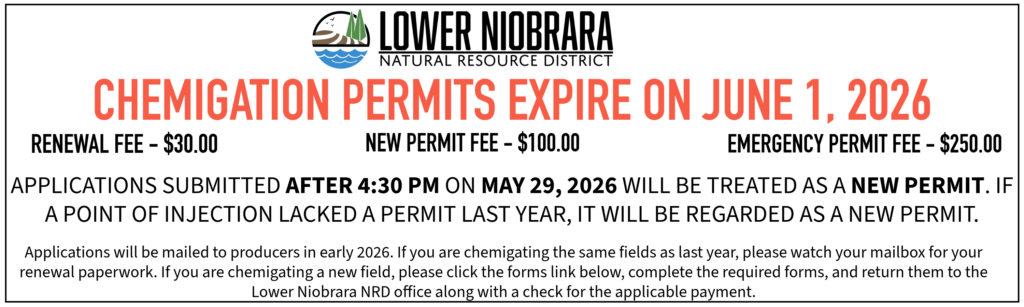
Chemigation Program
The Chemigation Program is responsible for protecting the irrigation water source from contamination by fertilizer or pesticides, as established in the Nebraska Chemigation Act. When fertilizer or pesticides (i.e., fungicide, herbicide or insecticide) are being applied through an irrigation system, the Chemigation Program and Nebraska’s 23 Natural Resource Districts (NRDs) work together to ensure that chemigation applicators and irrigation systems comply with the requirements of the Chemigation Act and Title 195, Rules and Regulations Pertaining to Chemigation
The NRDs are responsible for inspecting and permitting the specific safety equipment that must be installed on the irrigation system. The program has been well received, with a high degree of compliance.
The Department certifies all chemigation applicators. To receive certification, the applicators must complete training and testing, which is provided by the University of Nebraska Cooperative Extension system. Applicators must be re-certified every four years. Information about chemigation applicator training dates and certified applicators is provided at the bottom of this page
Chemigation Applicator Certification Training
2026 Chemigation Training Dates are now available. (Additional training dates will be added. If you don’t see trainings in your area check again later.) For the online training and exam, go to the University of Nebraska-Lincoln’s Chemigation Training and Certification webpage.
Chemigation Permitting
The Department of Water, Energy, and Environment supplies the form used to apply for a Chemigation permit to the Natural Resource Districts (NRD).
The applicant must complete the form, sign and date the application, and submit it with the appropriate fee to the appropriate NRD.
The NRD will assign a number to each permit application. In the case of permit renewal applications, the number from the previous year normally will be used for a particular site; but the portion of the permit number that indicates the previous year will be changed to reflect the current year.
Applications will be mailed to producers in early 2026. If you are chemigating the same fields as last year, please watch your mailbox for your renewal paperwork. If you are chemigating a new field, please click the forms link below, complete the required forms, and return them to the Lower Niobrara NRD office along with a check for the applicable payment.
If you have any questions or need assistance, please contact the Lower Niobrara NRD at 402-775-2343 or lnnrd@lnnrd.org.
- NEW RENEWAL PERMITS:
All new chemigation applications must be inspected prior to use. The LNNRD shall conduct an inspection and approve or deny the application within 45 days after receiving the application. A Certified Chemigation Applicator must be present with the NRD Inspector while inspection of the mainline check valve, vacuum relief valve, inspection port, low pressure drain, chemical line check valve and simultaneous interlock device is conducted. - EMERGENCY CHEMIGATION PERMITS:
An Emergency Permit may be filed and the LNNRD will have 2 working days (Monday- Friday) (excluding Saturday & Sunday and Federal or State Holidays) to issue or deny the permit. An Emergency Permit shall be valid for 45 days from the issuance date.
- CHEMIGATION RENEWAL PERMITS:
All permits must be renewed annually. Permits expire on June 1 of each year. The LNNRD is required to conduct random inspections of renewal permits and a Certified Chemigation Applicator must accompany the NRD Inspector during the inspection. If permits are not renewed prior to June 1st they must be considered as a new permit. The new permit fee is required along with an inspection prior to injecting any chemicals/fertilizer through the system. - SPECIAL CHEMIGATION PERMITS:
If the chemigation system does not need all the safety equipment, the LNNRD shall forward such information to the DEQ for review. If DEQ agrees with the LNNRD’s determination they shall grant the LNNRD authority to issue a Special Permit.
Reporting Accidents
Any actual or suspected accident relating to the use of chemigation must be reported within 24 hours of discovery.
Notification should include, if known:
- Time of occurrence
- Quantity and type of material involved
- Location of the incident
- Corrective or cleanup actions currently being taken
Notification must be made by telephone during normal business hours to:
| Nebraska Department of Water, Energy, and Environment | Lower Niobrara NRD |
|---|---|
| (402) 471-2186 | (402) 775-2343 |
After normal business hours, on weekends, or on holidays, notification must be made to the Nebraska State Patrol.