Open House held Celebrating 50 Years of NRD’s

Throughout 2022, Nebraska Natural Resources Districts (NRDs) are celebrating 50 years, commemorating breakthroughs, and achievements in conservation. The Lower Niobrara NRD held an Open House July 14th to celebrate and a chance to look back at pictures and memories of how the NRD has changed and grown in the past 50 years. Thank you to all who came to the office and enjoyed the amazing cake and cookies, shared memories, and stories with us and most of all helped us celebrate our 50th anniversary.

“We are proud to celebrate five decades of protecting, conserving and improving Nebraska’s nature resources.” Said Dr. Orval Gigstad, Nebraska Association of Resources Districts president. “It’s amazing to see the conservations progress that has been made these last 50 years and NRD directors and staff know the work we do today – planting trees, water management, soil health- will directly impact our future.”

After the devastation of the Dust Bowl, special purpose districts were developed to sole local soil and water-related problems. But the puzzle of overlapping authorities and responsibilities provided confusion at best.

In 1969, Senator Maurice Kremer introduced legislative bill 1357 to combine Nebraska’s 154 special purpose entities into 24 Natural Resources Districts by July 1972. In 1989, The middle Missouri Tributaries NRD and the Papio NRD merged to become the Papio-Missouri River NRD resulting in today’s 23 Natural Resources Districts.

Today, Nebraska’s unique system of locally controlled, watershed-based conservation is widely admired throughout the nation. NRDs deliver several state and federal programs including many projects with the U.S. Department of Agriculture Natural Resources Conservation Service (NRCS), Nebraska Department of Environment and Energy (NDEE), Nebraska Department of Natural Resources (NeDNR) and the University of Nebraska. These partnerships equate into real dollars for Nebraska agriculture and communities.

Across the state, Natural Resources Districts construct projects, implement programs and aid landowners in conservation and natural resources management. When necessary, they enact regulations to protect our resources. While all NRDs share the 12 main responsibilities, each district sets its own priorities and develops its own programs to best serve and protect Nebraska’s natural resources. Often the most recognizable NRD responsibilities include groundwater management, flood protection and conservation trees.

Since being created in 1972, NRDs have experienced tremendous growth in the responsibilities given to them by state statute, especially in protecting groundwater.  Despite being the No. 1 irrigated state in the nation, Nebraska’s statewide groundwater levels have been sustained at levels less than a foot below the pre-irrigation development in the 1950s.  In some areas, groundwater levels are even higher.  Many states are facing massive groundwater declines with almost depleted aquifers. 

Today the Lower Niobrara NRD covers approximately 1.7 million acres. We have adopted voluntary IMP on March Marc 3,2014. We developed well and acre ranking models, certified all groundwater irrigated acres and recently added 700 new irrigated acres and approved 9 new wells. We currently have 238,000 irrigated acres, 2686 active irrigated wells. Groundwater irrigation accounts for over 90% of all the irrigation in our district. We issue over 1,389 chemigation permits per year, sell around 12,200 trees and shrubs yearly, present in all elementary schools in our district. We are part of the Bazile Groundwater Management Area (BGMA) along with 3 other districts. We have the West Knox Rural Water District in Verdigre which serves 250 rural customers plus villages of Verdigre and Winnetoon.

West Knox Wellhead Protection Plan

NOTICE OF PUBLIC HEARING

WEST KNOX WELLHEAD PROTECTION PLAN

Public Hearing

August 24, 2-4 pm

ZCBJ Hall

401 S Main Street

Verdigre, NE 68783

The Lower Niobrara Natural Resources District (LNNRD) will hold a public hearing regarding a Wellhead Protection Plan for the West Knox Rural Water System in Knox County in Nebraska. The meeting will be held at ZCBJ Hall on August 24th from 2-4 pm.

This public hearing is being held to receive public feedback, provide information about the wellhead protection plan development process, why the plan is needed, and the best management practices associated with a wellhead protection area. The goal is to establish a recommended plan that is supported by the public and the LNNRD.

All interested persons are invited to attend and present relevant comments and questions. Project information will be available and personnel from the LNNRD and the consultant team will be present to answer questions and receive comments. A formal presentation will not be included as part of this public hearing. The information open house format allows the public to come at any time during the advertised hours, gather pertinent information about the project, speak one-on-one with project personnel, and leave as they wish.

LNNRD will make every reasonable accommodation to provide an accessible meeting facility for all persons. Appropriate provisions for the hearing and visually challenged or persons with Limited English Proficiency (LEP) will be made if the LNNRD is notified by August 1, 2022. The public is being encouraged to make suggestions or express concerns regarding this proposed project. Comments will be collected through August 24, 2022. Written comments or requests should be submitted to: Stacey Roach, Olsson, 601 P Street, Suite 200, Lincoln, NE 68508; sroach@olsson.com; telephone 402-458-5042.

Information regarding the proposed project (including the draft plan) has been made available on the project website at https://lnnrd.org/about/west-knox-rural-water/. For those without internet access, please contact the individual above.

ACE Camp Scholarship Winner

The Lower Niobrara NRD awarded John Wendt a scholarship to attend the Adventure Camp about the Environment (ACE Camp).  ACE camp is 4 days packed full of exploring, learning and outdoor fun at the State 4-H Camp in Halsey, NE. The camp is for youths is for 6th, 7th, and 8th graders. The camps sessions are on Forestry, Water, Range, Soils and Wildlife. John Wendt is a son of Michael and Brenda Wendt from Bristow NE. John presented to the LNNRD board about is time spent at the camp. His favorite activity was making and launching bottle rockets which his team placed 2nd.  There were approximately 70 kids that attended ACE camp this year. John stated that he really enjoyed the camp and is hoping to go next year.

Lower Niobrara NRD Board Votes for New Irrigated Acres

The Lower Niobrara Natural Resources District, Board of Directors, voted to allow up to 500 approved, new ground water irrigated acres in the District at their June 3rd meeting. The Lower Niobrara NRD will be accepting applications starting July 1st, 2022 and ending August 31st, 2022. An application will include a nonrefundable fee, an aerial photo of the property to be irrigated, location of all existing well, location of proposed new well, a test hole log within 330 fee of the new well location and must be submitted by the landowner. Each application will be ranked for soil, well and ground water criteria according to the Rules and Regulations of the Lower Niobrara NRD. All applicants will be notified by October 31st, 2022 of their application approval or denial for new ground water irrigated acres. The maximum allowed approved new ground water acres per person or entity is 160 acres and will also follow the Rules and Regulations of the Lower Niobrara NRD.

Contact the Lower Niobrara Natural Resources District in Butte at (402)775-2343 for an application or questions regarding the 2022 new irrigated acre program.

In accordance with LNNRD’s Integrated Management Plan, the Nebraska Department of Natural Resources (NDNR) can also allow new surface water irrigation appropriations for up to 167 acres. All surface water questions and applications should be submitted to NDNR.

Let’s Talk About Nitrogen
NRD’S Celebrate 50 Years of Natural Resources Partnerships

For Immediate Release

Feb. 7, 2022

Contact

Megan Grimes, Public Relations Director

Office: 402.471.7672

Cell: 402.419.4235

mgrimes@nrdnet.org

NRDs Celebrate 50 Years of Natural Resources Partnerships

LINCOLN, Nebraska – Nebraska’s Natural Resources Districts (NRDs) have worked hand-in-hand with conservation partners to support landowners for 50 years to accomplish the mission of protecting lives, property and the future.

NRDs deliver several state and federal programs including many projects with the U.S. Department of Agriculture Natural Resources Conservation Service (NRCS), Nebraska Department of Environment and Energy (NDEE), Nebraska Department of Natural Resources (NeDNR) and the University of Nebraska. These partnerships equate into real dollars for Nebraska agriculture and communities.

“Nebraska policymakers had incredible foresight when creating the NRDs realizing that our strength lies in collaboration with partners to champion conservation,” said Jim Eschliman, Nebraska Association of Resources Districts president. “Our partnerships with local, state and federal agencies have helped deliver conservation to millions of acres across Nebraska to reduce soil loss and improve water quality and quantity.”

Last year alone, NRCS applied over 11,000 conservation practices on more than 865,000 acres across Nebraska. These conservation practices leverage the work of the NRDs by helping Nebraska’s farmers and ranchers improve soil health, increase irrigation efficiency, and make grazing land more productive.

“NRCS and the NRDs have been working hand-in-hand for the past 50 years,” said Stacy Riley, acting state conservationist for Nebraska NRCS. “Nebraska’s landowners are fortunate to have the strong partnership between NRCS and the NRDs. Through this partnership, more conservation opportunities are available to farmers and ranchers to help improve and conserve their natural resources. And that benefits all Nebraskans.”

When it comes to protecting Nebraska’s water quality, NRDs work closely with the Nebraska Department of Environment and Energy to improve surface water, groundwater and drinking water through projects that target non-point source pollution.

In 2018, two Nebraska watersheds – Antelope Creek and Shell Creek – were removed from the impaired waters list thanks to collaborative efforts with many state and federal agencies including NDEE.

Antelope Creek is an urban stream that lies entirely within Lincoln and is part of the Lower Platte South NRD. NDEE listed Antelope Creek as impaired for E. coli bacteria in 2004. Collaborative efforts over 20 years with multiple partners and implementation of numerous projects resulted in significantly reduced E. coli levels and Antelope Creek was removed from the impaired waters list.

Shell Creek includes more than 300,000 acres, stretching from Newman Grove to Schuyler in the Lower Platte North NRD. The Shell Creek Watershed Improvement Group (SCWIG) is a group of landowners and farmers who worked collaboratively with NDEE, Lower Platte North NRD, and other project partners in promoting no-till farming, filter and buffer strips, cover crops, and other best management practices to help improve the quality of water draining into Shell Creek. As a result of these conservation efforts, the atrazine level significantly declined and the creek was removed from the impaired waters list, and now supports aquatic life.

“These delistings show how multiple partners have come together to significantly improve water quality in Nebraska,” said Jim Macy, director of the Nebraska Department of Environment and Energy. “This is an extremely difficult and rare thing to accomplish resulting from the implementation of a comprehensive watershed management plan. We look forward to continuing our work with Nebraska’s NRDs to provide safe, quality water for our state.”

As the No. 1 irrigated state in the nation, managing Nebraska’s water to ensure there is enough for domestic, industrial and agricultural purposes is essential. The Nebraska Department of Natural Resources works with NRDs to develop local and basin-wide integrated management plans to sustain a balance between water supplies and uses and protect the rights of existing water users.

In the Upper Platte Basin, the rehabilitation of irrigation canals for conjunctive water management efforts has allowed for groundwater recharge and kept more water in the state. Proactive management and the creation of a water tracking program in the Lower Platte Basin helps water managers evaluate supplies and demands. In the Republican Basin, a water balance forecasting system allows producers to plan for the irrigation season. Across the state, NeDNR works closely with NRDs to ensure existing water users are protected now and into the future.

“Working together, the Department of Natural Resources and the NRDs continue to build on the strong foundation of using water-use and water-supply data for decision-making and informing policymakers and citizens alike,” said Tom Riley, NeDNR director. “Together we create resilient programs to balance Nebraska’s water use and supply.”

To ensure producers have the latest research and understanding of best management practices, NRDs work with the University of Nebraska on demonstration plots, educational workshops, data collection and more.

“The Nebraska Water Center has long appreciated the NRDs commitment to partnering with the University to support research and education statewide,” said Dr. Chittaranjan Ray, Director of the Nebraska Water Center, Daugherty Water for Food Global Institute at the University of Nebraska. “These partnerships connect cutting-edge research to local challenges, benefiting all Nebraskans. Most importantly, our collaborations support students to become the next generation of conservation leaders.”

Eschliman noted that the Natural Resources Districts have numerous partners around the state that contribute knowledge, funds and time to help conserve Nebraska’s resources for future generations.

“Our work would not be as successful without the support of these valued partners,” Eschliman said. “We’re excited for what we will accomplish together in the next 50 years.”

Throughout 2022, the NRDs will commemorate breakthroughs and achievements in conservation. To join in the celebration and follow the Natural Resources Districts’ special activities throughout 2022, visit nrdnet.org and follow #Since1972 on social media.

The Nebraska Association of Resources Districts (NARD), the trade association for Nebraska’s 23 Natural Resources Districts (NRD), works with individual districts to protect lives, property and the future of Nebraska’s natural resources. NRDs are unique to Nebraska, and act as local government entities with broad responsibilities to protect Nebraska’s natural resources. Major Nebraska river basins form the boundaries of the 23 NRDs, enabling districts to respond to local conservation and resource management needs. Learn more about Nebraska’s NRDs at www.nrdnet.org.

###

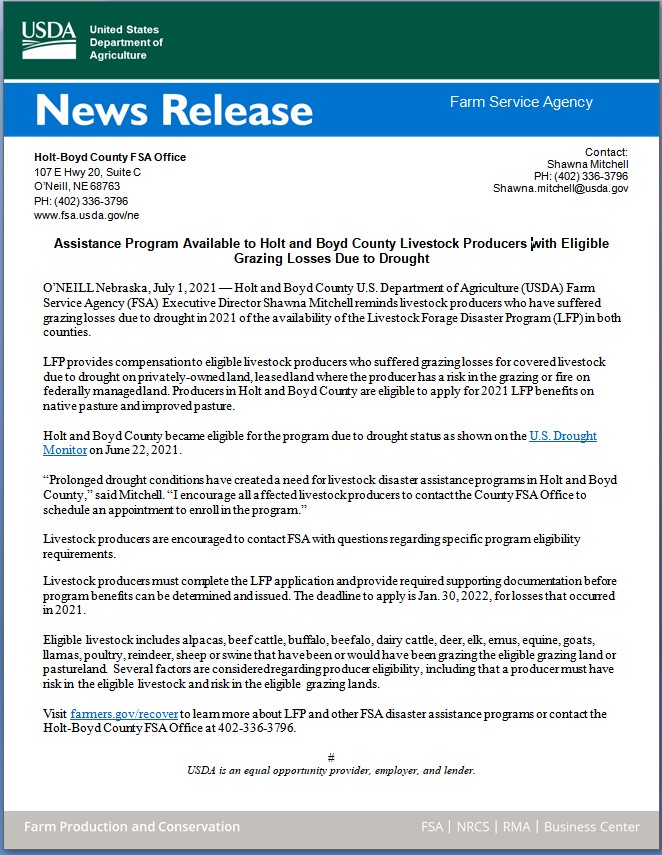
LFP Program
2021 New Irrigated Acre Parameters

For Immediate Release

Lower Niobrara NRD Board Votes for New Irrigated Acres

The Lower Niobrara Natural Resources District, Board of Directors, voted to allow up to 1000 approved, new ground water irrigated acres in the District at their June 4th meeting.  The Lower Niobrara NRD will be accepting applications starting July 1st, 2021 and ending August 31st, 2021.  An application will include a nonrefundable fee, an aerial photo of the property to be irrigated, location of all existing wells, location of proposed new well, a test hole log within 330 feet of the new well location, and must be submitted by the landowner.  Each application will be ranked for soil, well, and ground water criteria according to the Rules and Regulations of the Lower Niobrara NRD.  All applicants will be notified by October 31st, 2021 of their application approval or denial for new ground water irrigated acres.  The maximum allowed approved new ground water irrigated acres per person or entity is 160 acres and will also follow the Rules and Regulations of the Lower Niobrara NRD. 

You can find the 2021 new irrigated acre application on the website www.lnnrd.org or contact the Lower Niobrara Natural Resources District in Butte at (402) 775-2343 for an application or questions.

In accordance with our Integrated Management Plan, the Nebraska Department of Natural Resources (NDNR) can also allow new surface water irrigation appropriations for up to 333 acres.  All surface water questions and applications should be submitted to NDNR.

Time is running out!!
Expire on June 1st
Press Release